
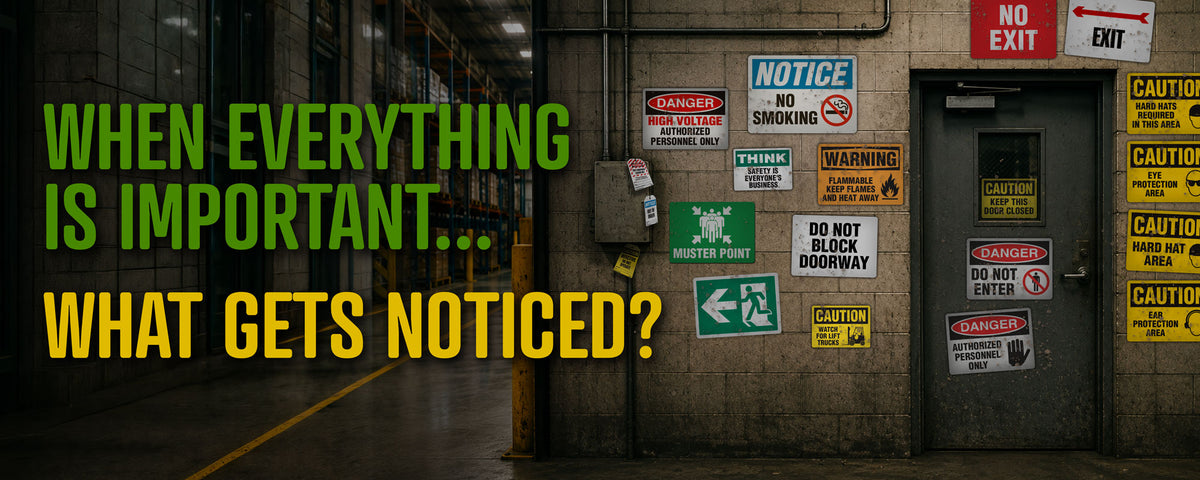
Safety signs are an important part of workplace communication. But there comes a point where adding another sign doesn't necessarily make an area clearer.
Walk through a busy warehouse, plant or maintenance area and you may see signs on walls, notices on doors, labels on equipment, instructions at workstations and temporary messages added over time.
Individually, every message may have a reason for being there.
Together, they can become noise.
When Everything Is Important
The problem with too much visual information is surprisingly simple.
When everything is trying to get your attention, it becomes harder to know what deserves your attention first.
A critical warning may be competing with:
- General information
- Directional signs
- Old notices
- Equipment instructions
- Temporary messages
- Multiple signs communicating similar information
The issue isn't necessarily that any one message is wrong. It's whether the overall environment still communicates clearly.
More Isn't Always Clearer
When a new safety concern appears, adding a sign can seem like the obvious solution.
Sometimes it is.
But before adding another message, it can be useful to ask a different question:
Is a sign actually the best way to communicate this information?
A message about pedestrian movement, for example, may be more effective when reinforced by floor markings.
Equipment status may be clearer on a tag attached directly to the equipment.
A temporary restricted area may be better defined by a physical boundary or barricade.
A hazard associated with a specific container, pipe or piece of equipment may need identification at the point where someone interacts with it.
The goal isn't to use fewer safety products. It's to use the right type of communication in the right place.
Put the Message Where the Decision Happens
One useful way to think about safety communication is to consider the moment when someone needs the information.
If a worker needs to decide whether a piece of equipment should be operated, where will they naturally look?
If a forklift driver is approaching a pedestrian crossing, where should that information appear?
If someone is about to enter a restricted area, at what point do they need to know?
The closer useful information is to the actual decision, the less someone has to search for it or remember something they saw earlier.
That can mean using:
- Signs for hazards and instructions that need to be visible from a distance
- Tags for equipment status and information at the point of use
- Labels for identification directly on equipment, containers or other surfaces
- Floor markings and graphics for traffic flow, walkways and designated areas
- Barricades and tapes for boundaries or temporary restrictions
Each communicates differently.
The Signs Everyone Has Stopped Seeing
There's another challenge with visual communication: familiarity.
A sign can remain physically present while gradually becoming part of the background.
That's especially worth considering when an area has accumulated messages over many years. Some may still be important. Others may have become redundant, outdated or poorly positioned as the workplace changed around them.
Periodically looking at an area with fresh eyes can help.
Ask:
- What is the most important message here?
- Is it immediately obvious?
- Are several messages competing for attention?
- Is anything outdated or no longer relevant?
- Could some information be communicated more effectively somewhere else?
You don't necessarily need more communication.
You may need clearer communication.
Think Beyond the Wall
Safety communication doesn't have to begin and end with a sign.
The workplace itself can communicate through colour, location, boundaries, identification and repeated visual cues.
A walkway can tell people where to move.
A tag can tell someone the status of equipment.
A floor graphic can reinforce a message exactly where it's needed.
A barricade can make a boundary immediately apparent.
A label can put information directly at the point of interaction.
Used together thoughtfully, these different forms of communication can create an environment that is easier to understand without simply adding more signs.
A Simple Test
The next time you walk through your facility, don't count the number of safety signs.
Instead, choose a few important areas and ask:
If I didn't already know this workplace, would I know what to do here?
If the answer isn't immediately clear, another sign may be the solution.
But it may not be.
Sometimes better safety communication starts by deciding what needs to be communicated, where someone needs to see it, and which visual tool communicates it best.
Final Note
This article is intended for general information only. Safety requirements can vary by jurisdiction and application, and facilities should confirm which regulations or standards apply to their specific operations.


