
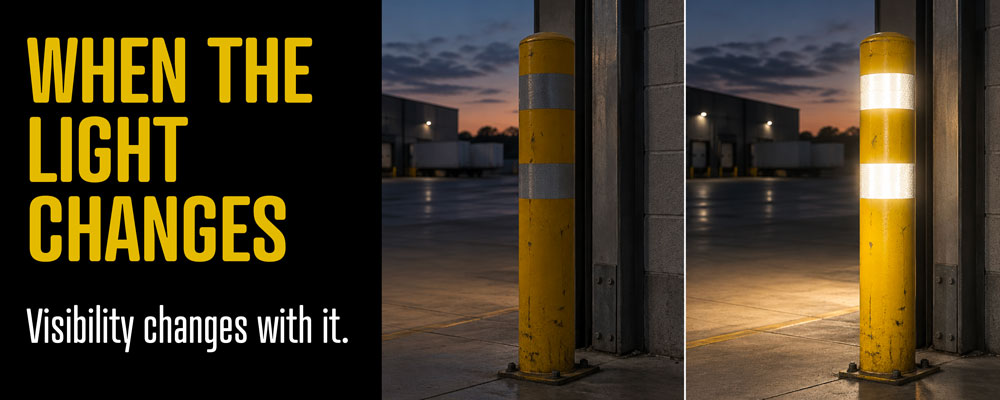
As daylight hours get shorter, areas that seemed well-lit through the summer can look very different at the beginning or end of a shift.
Outdoor equipment, loading areas, yards, entrances and vehicles may all become harder to see in lower-light conditions. Reflective tape can help improve visibility, but choosing the right material involves more than simply picking a bright colour.
The application, viewing distance, lighting conditions and surface all matter.
How Does Reflective Tape Work?
Many reflective safety tapes use retroreflective materials. Instead of simply reflecting light in different directions, these materials are designed to return a significant amount of light back toward its source.
That's why reflective markings can become much more noticeable when illuminated by headlights, flashlights or other directed light.
This can be particularly useful where objects, boundaries or hazards need to remain identifiable as lighting conditions change.
Not All Reflective Tape Is the Same
A quick search for reflective tape can bring up terms such as:
- Adhesive reflective tape
- Industrial reflective tape
- Prismatic reflective tape
- High-intensity reflective tape
- Conspicuity tape
While these products all use reflection to improve visibility, they are not necessarily interchangeable.
Different constructions can provide different levels of reflectivity, durability, flexibility and performance at distance. Some are intended for general industrial identification, while others are designed for more demanding outdoor or transportation applications.
Rather than choosing based on appearance alone, start with where and how the tape will be used.
Start With the Viewing Conditions
Consider when the marking needs to be visible.
Is it primarily needed:
- Inside a warehouse?
- In an outdoor yard?
- Around loading areas?
- At entrances or access points?
- On equipment or machinery?
- In an area exposed to vehicle headlights?
- From nearby or at a greater distance?
A highly reflective material may provide little additional benefit in an application that is always brightly illuminated. In a darker environment where the marking is viewed under directed light, the difference can be much more noticeable.
Understanding the viewing conditions helps narrow down the appropriate material.
Consider Distance
A reflective marking that works well when viewed from a few feet away may have a very different job from one intended to identify an object from across a yard or farther down a roadway.
For longer viewing distances, factors such as:
- Reflective performance
- Size of the marking
- Contrast with the surrounding surface
- Angle of approach
- Available light source
can all affect how easily something is recognized.
This is one reason reflective material shouldn't be selected on reflectivity alone. The complete visual message still needs to be large, clear and appropriately positioned.
Colour Still Has a Job to Do
Reflectivity and colour serve related but different purposes.
Colour can help create contrast and distinguish one marking from another during normal lighting conditions. Reflectivity can help that marking remain noticeable when illuminated in lower light.
Depending on the application, reflective tapes are available in colours such as:
- White
- Yellow
- Red
- Orange or amber
- Other identification colours
Colour selection may also be influenced by specific workplace, transportation or regulatory requirements, so the application should always be considered before choosing a colour.
Don't Forget the Surface
Even the right reflective material needs a suitable surface.
Before applying adhesive reflective tape, consider whether the surface is:
- Clean and dry
- Smooth or textured
- Painted, bare metal or another material
- Flat or curved
- Indoors or exposed to weather
- Subject to frequent cleaning, abrasion or impact
Surface preparation and application conditions can affect how well adhesive tape bonds and how long it remains in place.
For demanding environments, durability can be just as important as initial reflectivity.
Reflective Tape Is Part of a Larger Visibility System
Reflective tape can make an object easier to identify, but it shouldn't be expected to solve every visibility problem by itself.
Lighting, placement, contrast, signs, markings and the surrounding environment all contribute to what someone sees.
A useful question to ask is:
What needs to be noticed, from where, and under what conditions?
Once those three things are understood, choosing the appropriate reflective material becomes much easier.
Visibility When the Light Changes
Low-light conditions don't only occur at night.
Early mornings, late afternoons, poorly illuminated areas, bad weather and changing seasonal daylight can all affect how clearly an environment is understood.
Reflective materials provide another way to maintain visual communication as those conditions change.
The goal isn't simply to make something shine.
It's to make important information or objects easier to recognize when visibility becomes more difficult.
Explore Reflective Options
INCOM offers reflective tapes and marking products for a range of industrial and safety applications.
Final Note
This article is intended for general information only. Safety requirements can vary by jurisdiction and application, and facilities should confirm which regulations or standards apply to their specific operations.


